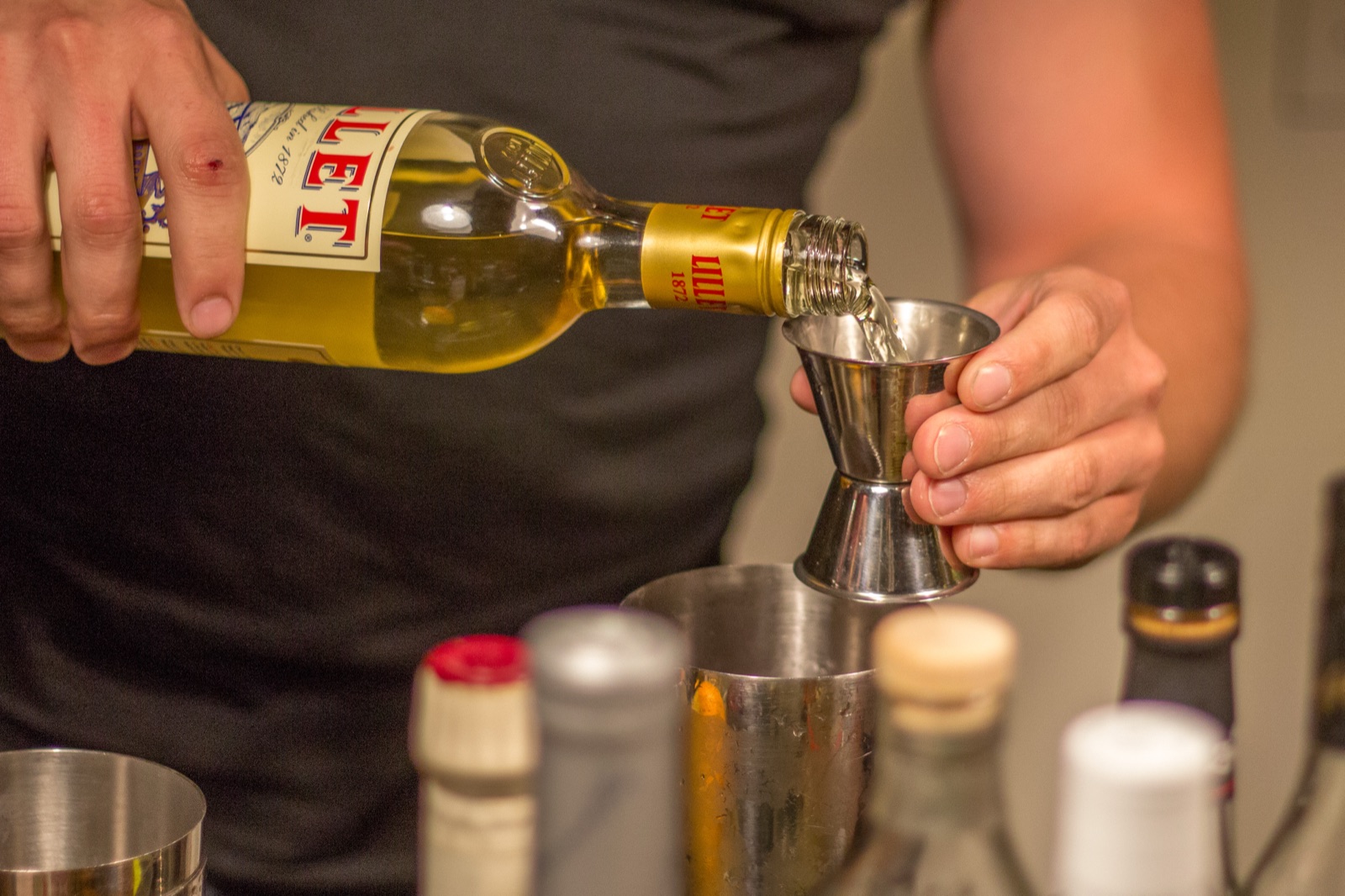
Cocktail tools are often sold as a complete little bar. The shaker, strainer, spoon, tongs, and jigger line up nicely in the box. Once the set reaches a real kitchen, the jigger is often the piece that keeps returning to the counter.
When I look at one now, I start with recipes rather than finishes. If 1/2 oz, 1 oz, and 1 1/2 oz keep appearing in drinks I actually want to make, the tool earns its place. If the routine is brewed coffee, Americanos, and lattes, a kitchen measure already does the job.
A 1 oz/2 oz jigger still needs the right lines
The common 1 oz/2 oz (30/60 ml) double jigger covers a useful range. Each end reaches its stated capacity at the rim.
The interior is less predictable. One model may mark 1/2 oz and 1 1/2 oz. Another may omit one of them or use a different set entirely. A listing that says 1 oz/2 oz tells you the brim capacities, not every line hidden inside.
I would rather see a clear interior photo than another angle of a gold or hammered finish. A 1/2 oz/1 oz jigger can be excellent for small pours, although 1 1/2 oz and 2 oz then take several fills. That becomes surprisingly easy to lose track of when making more than one drink.
Dark liquids reveal bad markings
Fine lines can look acceptable with water and disappear behind coffee, dark liqueur, or syrup. Kitchen lighting is rarely designed for reading a tiny steel cup, so crowded or shallow marks become annoying fast.
The rim matters too. A clean edge empties in one motion. A thick, rounded edge gives sticky syrup more opportunity to crawl down the outside. This is a small flaw that announces itself every time you wipe the counter.
Give a new jigger one pour of water
If a line looks suspicious, check it with room-temperature water and a kitchen scale. One milliliter of water weighs about one gram, close enough for a home check. The point is simply to catch a decorative or badly placed mark.
Without a jigger, a level tablespoon is about 1/2 oz (15 ml), and a marked kitchen mini measure works well. Buy the dedicated tool when 1 teaspoon differences begin to matter, or when repeated 1 1/2 oz pours become a nuisance. By then, you will know exactly which lines you need.
FAQ
Is a 1 oz/2 oz jigger best for beginners?
It is the most flexible single size when it also includes useful internal marks. A 1/2 oz/1 oz model is fine if your recipes never need larger pours.
Can I use a tablespoon instead?
Temporarily, yes: a level tablespoon is about 1/2 oz / 15 ml. It becomes awkward when you need 1 tsp / 5 ml changes or repeated pours.
Do coffee drinks need a jigger?
Not basic coffee. It becomes useful when you regularly add syrups, citrus, tonic, sparkling water, or spirits and want repeatable results.
Are the jiggers in cocktail sets good enough?
Check the markings rather than the bundle. A decorative, unmarked small jigger may be less useful than one graduated cup.
Sources
- Diageo Bar Academy — How to Use a Jigger Like a Pro
The industry guide lists common 15/30, 25/50, and 30/60 ml combinations and warns that actual volumes vary by country, style, and brand. That supports checking the tool in hand rather than treating one size as universal.
- Urban Bar / Cocktail Kingdom — Japanese Style Jigger 1 oz / 2 oz
This model lists 30/60 ml brim capacities and 15/22/45 ml interior marks. It is a concrete product example, not proof that every 30/60 ml jigger has the same internal lines.