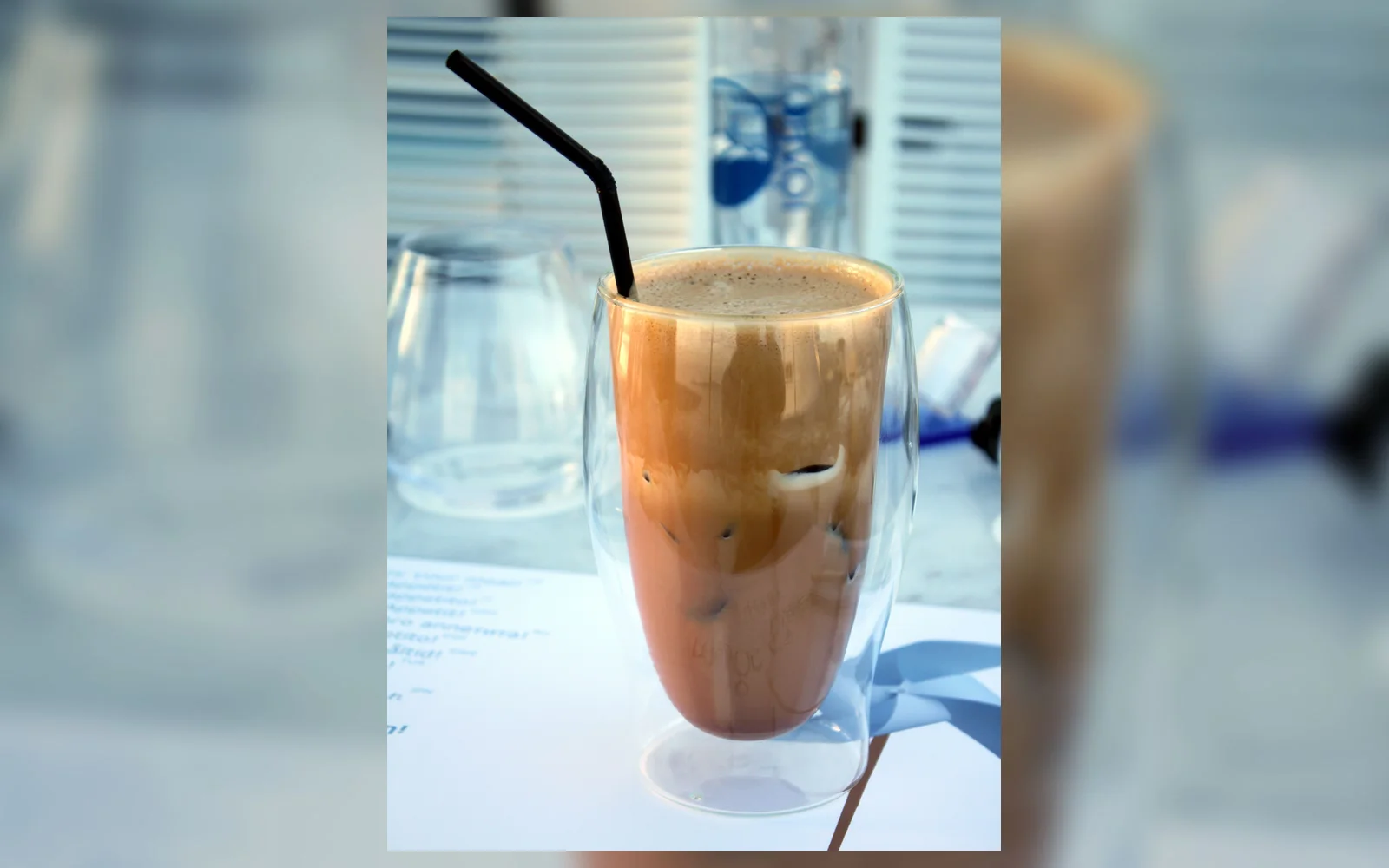
Do not dissolve the instant coffee into a full glass first. A Greek frappé starts by foaming 2 teaspoons instant coffee with just 2 tablespoons (30 ml) cold water, then adding ice and about 1/2 cup (120 ml) more cold water. Too much water at the start makes dense foam harder to build with a home frother or jar.
This is more than chilled instant coffee
Greek frappé is recognized by the tan foam made when instant coffee and a little cold water are vigorously mixed. Whipped cream, crushed ice, and flavored syrup are not what define it.
Ground coffee is not a direct substitute. Espresso can make a good iced drink, but it does not create the same classic instant-coffee foam; make shaken espresso instead if that is what you have.
The first glass needs only four basics
Combine 2 teaspoons plain instant coffee, optional sugar, and 2 tablespoons (30 ml) cold water in a tall narrow cup. Froth for 10-15 seconds, or shake a sealed jar hard for about 20 seconds. Stop when the liquid turns noticeably lighter and the foam reaches two or three times the original volume.
Pour it over a glass half-filled with ice, then add about 1/2 cup (120 ml) cold water down the side. Make the first cup without milk so you can tell whether it is too bitter or too weak; add 2 tablespoons cold milk to the next one if you want a softer finish.
No frother? Check the lid first
A jar is not merely a compromise: shaking is a traditional route for pulling air into the coffee concentrate. But the jar must have a gasket and stay fully sealed.
Test it with plain water. If it seeps, do not hold the lid down and hope for the best. Changing containers is easier than cleaning coffee from the counter.
Fix one symptom at a time
No foam usually means the first water dose exceeded 2 tablespoons, or the coffee was not instant.
If it is too bitter, reduce the next cup to 1 1/2 teaspoons coffee. If it tastes weak, reduce the finishing water by about 1 tablespoon plus 1 teaspoon (20 ml). Do not change coffee, sugar, and water at once, or the next cup will teach you nothing.
Once the foam exists, ice and cold water simply turn it into a long, slow iced coffee. Get that first 30 ml right; owning an espresso machine is beside the point.
Recipe reference
Keep this recipe handy
Ingredients
- 2 teaspoons (about 4 g) plain instant coffee; do not use ground coffee or a 3-in-1 mix
- 2 tablespoons (30 ml) cold water for foaming
- About 1/2 cup (120 ml) cold water to finish
- 5-6 ice cubes
- 0-2 teaspoons granulated sugar, optional
- 2 tablespoons (30 ml) cold milk, optional
Tools
- 10-12 oz (300-350 ml) tall glass
- Handheld frother or a truly leakproof jar
- Teaspoon and tablespoon or small measuring cup
Method
- Add instant coffee, optional sugar, and 2 tablespoons (30 ml) cold water to a narrow cup or leakproof jar.
- Froth for 10-15 seconds, or seal and shake the jar hard for about 20 seconds, until the mixture turns lighter and expands to two or three times its starting volume.
- Pour the foam into a tall glass half-filled with ice, then add about 1/2 cup (120 ml) cold water down the side.
- For a softer cup, add 2 tablespoons (30 ml) cold milk after the foam, ice, and water are in place.
- Drink through a straw from below the foam. The foam is coffee foam, not milk foam, and it will gradually thin.
Use what you have
- No frother: shake in a gasketed, leakproof jar for about 20 seconds. The bubbles may be coarser, but the 30 ml concentrate still foams more readily than a full glass.
- Only 3-in-1 coffee: do not use this ratio. Premixed sugar and creamer make sweetness, concentration, and foam hard to control.
- Only ground coffee or espresso: make iced coffee or shaken espresso instead; neither is a one-for-one route to classic Greek frappé foam.
- No sugar: leave it out. The cup will taste more direct and bitter, and the foam may thin sooner.
- Want milk: add 2 tablespoons (30 ml) cold milk after foaming and dilution; it softens the cup but reduces coffee intensity.
If the result is off
- Little or no foam: too much water went into the first step, or ground coffee was used. Return to plain instant coffee and 2 tablespoons water.
- Foam forms but collapses quickly: the container is too wide, whipping stopped early, or an unsweetened cup sat too long. Use a narrow vessel and add ice as soon as the foam is ready.
- Too bitter: first dissolve any coffee at the bottom; next time reduce the instant coffee to 1 1/2 teaspoons.
- Too weak: reduce the finishing water by 1 tablespoon plus 1 teaspoon (20 ml) next time.
- The jar leaks: stop and change to a gasketed jar or a frother; do not try to hold down an unsuitable lid while shaking.
Cost and effort
A serving uses about 4 g instant coffee plus ice and water, usually well under US$1. Check that the jar seals before buying a dedicated machine.
FAQ
Is Greek frappé the same as a Frappuccino?
No. Greek frappé starts with instant coffee and a small amount of water whipped into foam, then adds ice and water. A Frappuccino-style drink is generally a sweeter blended drink with milk, syrup, and crushed ice.
Do I need a particular instant-coffee brand?
No. Start with plain instant black coffee with a short ingredient list. Products differ in foam and bitterness, so adjust the next cup by 1/2 teaspoon.
Why not add all the water before shaking?
A large water volume spreads the coffee and air through too much liquid for a home frother or jar to build dense foam quickly. Make the 30 ml concentrate first, then dilute it.
Can Greek frappé be made without sugar or milk?
Yes. Both are optional in the basic Greek structure. The unsweetened, milk-free cup is more bitter and direct, and its foam may thin sooner.
How much caffeine is in a Greek frappé?
It depends on the product and actual coffee weight. NESCAFÉ Greece gives about 40 mg caffeine per gram for its product, so 4 g could approach 160 mg. Caffeine-sensitive readers, pregnant people, and anyone drinking it late should use less coffee and check the package.
Sources
- Visit Greece — Coffee pleasure, the Greek way
Confirms the Greek cold-water shaker method and that sugar and milk are optional.
- NESCAFÉ — Frappé Rezept
Supports the official home method of foaming 2 teaspoons instant coffee with a small amount of water before adding ice and cold water.