Start neutral, not flavored
If you make iced coffee, sours, or sparkling drinks only occasionally, the most useful first syrup is neutral 1:1 simple syrup. It fixes sweetness without deciding the whole flavor of the drink.
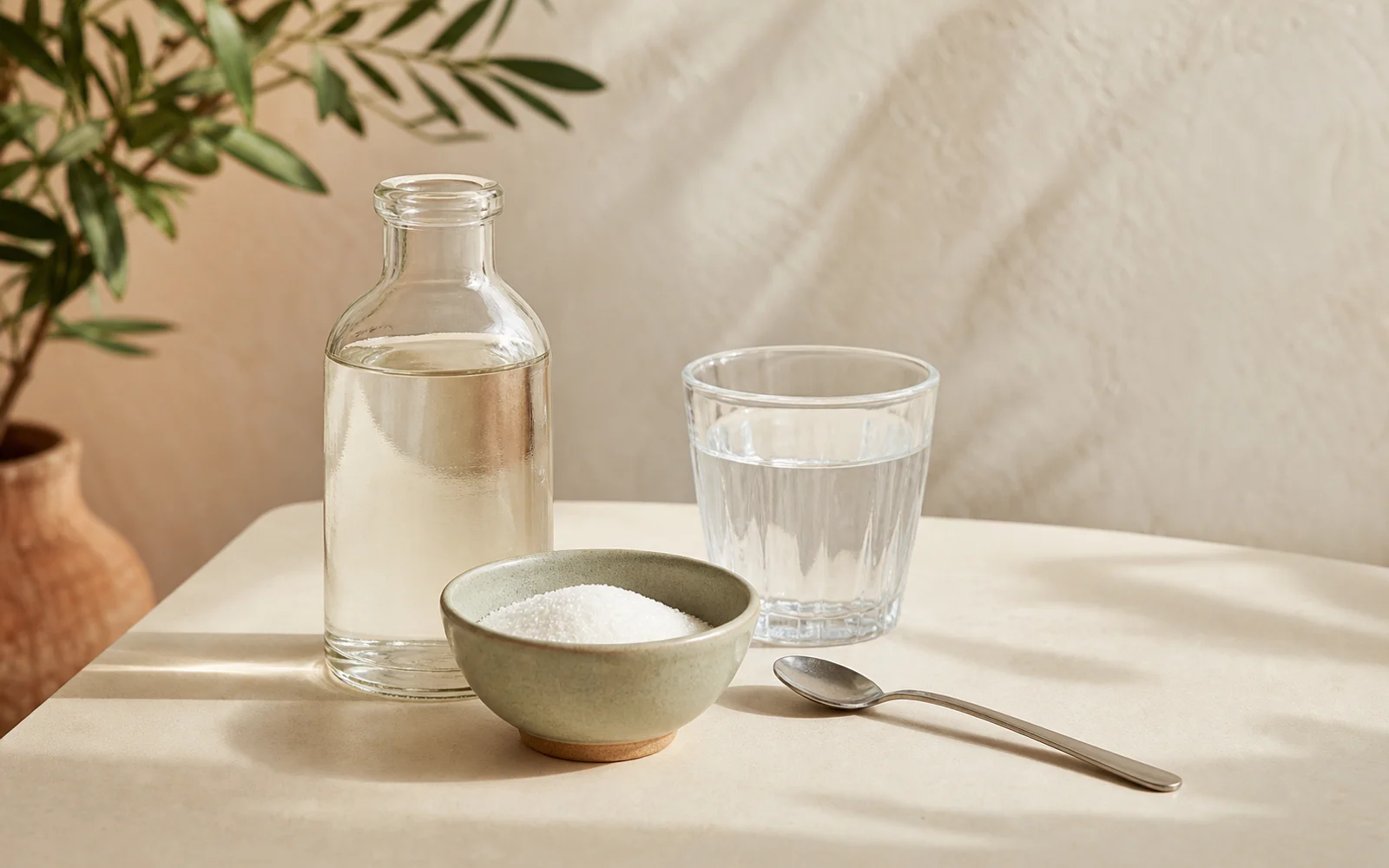
Dissolve 50 g (1.8 oz) sugar in 50 g (1.8 oz) hot water, cool it, and refrigerate it in a clean small bottle. The batch is large enough for several drinks but small enough to avoid a forgotten 750 ml bottle.
Ask what the syrup must do
Syrup has two different jobs. Use simple syrup when the drink only needs sweetness. Use flavored syrup when vanilla, hazelnut, caramel, fruit, flowers, or spice should be identifiable.
Combining those jobs often makes a drink too sweet before the flavor becomes as strong as expected.
Do not use 1:1 and 2:1 at the same volume
One-to-one means equal weights sugar and water. Two-to-one rich syrup uses two parts sugar to one part water, so it is sweeter and thicker per unit of volume.
If a recipe calls for 15 ml (1/2 oz) of 1:1 syrup, start with about 10 ml (1/3 oz) of 2:1. Do not automatically halve it, and do not pour the full 15 ml. Mix, then adjust in 2-5 ml increments.
When a recipe says only “simple syrup,” check whether its author defines the concentration.
Use the three-drink rule
Before buying a flavored bottle, name three drinks you genuinely expect to make.
Vanilla may earn a place if it will repeatedly go into iced lattes, milk tea, and a zero-proof soda. If it exists for one copycat drink, first use vanilla, cinnamon, citrus peel, or honey already in the kitchen. The result will differ, but you will not immediately create another large leftover bottle.
Frequent repeat use is the exception. If you make the same drink every week, the consistency and convenience of commercial syrup can be worth more than the ingredient savings.
Reduce regular syrup before changing systems
To lower sugar, first reduce regular syrup from 10 ml to 5 ml and see whether acid, bitterness, and carbonation remain balanced.
Low-sugar and sugar-free syrups use different sweeteners. Their sweetness may arrive or fade differently, so restart with a smaller amount instead of assuming equal milliliters will taste equal.
Change one thing in the next drink
If the drink is immediately too sweet, confirm whether you used 2:1 at a 1:1 dose, then reduce the next drink by 5 ml.
If flavored syrup hides the coffee or tea, halve it. If it still dominates, return to neutral simple syrup.
If homemade syrup develops mold, cloudiness, unusual bubbles, or an off odor, discard it without tasting. Make a smaller batch next time.
Start with 50 g sugar and 50 g water. Buy the next bottle only when one flavor has three real jobs.
FAQ
Does simple syrup mean 1:1 or 2:1?
Conventions vary. Many modern home recipes mean 1:1, while some bars and authors default to 2:1. Check the source; this guide always states the ratio.
Should 1:1 syrup be measured by weight or volume?
Weight is clearer for repeatable home batches: 50 g sugar plus 50 g water.
Can I use half as much 2:1 syrup?
Not as a general rule. By volume, 2:1 syrup is not twice as sweet as 1:1. For 15 ml of 1:1, start around 10 ml of 2:1 and adjust.
Should my first flavored syrup be vanilla or hazelnut?
Choose by actual use. If you cannot name three drinks you will make, hold off. If one flavor fits three repeat drinks, it has a reason to stay.
How long does homemade simple syrup last?
Home sanitation, containers, and refrigerator temperatures vary, so this guide does not promise a fixed duration. Refrigerate a small batch and discard it if you see mold, cloudiness, unusual bubbling, or smell an off odor.
Sources
- Food Network Kitchen — How to Make Simple Syrup
Food Network Kitchen defines standard syrup as equal parts sugar and water and rich syrup as two parts sugar to one part water, with cold-drink uses. BloomSipSip weighs small batches and treats the 2:1 conversion as a tasting start, not a universal storage guarantee.